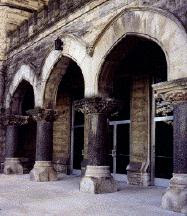
The fall semester is well underway and I have only begun to write.
So bere we go!!!
***********
Jonelle and Leo Comerford retired at the end of the spring semester
***********
Marshall Lassak has been apointed assistant Chair of the department
***********
William Green has accepted a position at Rose-Hulman
And we will miss him greatly.
***********
Two faculty members are on a leave of absence and tbe department is doing its best to
struggle through.
***********
The department has added some new faculty members but more details on
this will follow
***********
I am writing using a tablet since I am out of town at a computer conference and so I mike a lota miztakez
Saturday, October 6, 2012

Wednesday, April 25, 2012
Professor Baianu Lecture April 20th
Professor Ion Baianu (UIUC) spoke in the Department colloquium on April 20th on
THE `DUPLICITY’ OF MATHEMATICS IN THE REAL, IMPERFECT WORLD
Below is a sample of the abstract:
A new look at old, fundamental problems in Physics, Chemistry, Biochemistry and Biology will be presented from the point of view of modern Mathematics and Logics focused on complexity, asymmetry and symmetry concepts applied to fundamental problems in Life Sciences and Quantum Physics. The presentation is divided into two unequal parts consistent with the idea of the `duplicity’ of Mathematics when applied to nonlinear, highly complex problems in the real World. The first, concise, part introduces a few, logical and mathematical concepts that are essential to understanding both dynamic complexity and partially disordered structures (quasi-‐crystals, liquid crystals and paracrystals) in physical, chemical and biological systems—especially highly-‐evolved organisms such as Homo-sapiens.
The second part will present several fundamental aspects of modern biology approached from the point of view of complex systems and mathematical modeling.
Thursday, April 5, 2012
EIU Dynamics Conference this Weekend
The Department of Mathematics will host a conference this
weekend on dynamical systems. See department webpage for details.
Charles Delman to Talk
Charles Delman will give a talk Friday April 6 at 4 pm entitled
The Topology of Social Choice
Thursday, March 29, 2012
Konstantin Slutsky to Speak March 30th
From the Abstract:
In 1950, Mark Graev gave a construction of two-sided invariant metrics on free groups over metrics spaces. These metrics were later used in descriptive set theory to produce exotic Polish groups. We will describe a similar construction of metrics on free products (possibly with amalgamation) of groups with two-sided invariant metrics and discuss some applications. I will try to reduce preliminaries to minimum.
Tuesday, March 27, 2012
Update from Old Main
I have not been very good about posting during the last month or more. So here is an update on the news in the EIU Math and CS Department.
The department welcomes a new faculty member, Ravi Somayajulu, for the fall of 2012.
The College of Science will have a new Dean, Harold Ornes. Dean Ornes will start work in the college this upcoming summer. Dean Ornes is an aquatic botanist.
Professor Andrew Mertz gave a talk on Ipad/Ipod programming on February 24 and Professor Patrick Coulton and Professor Peter Andrews spoke on invisible objects on March 2nd.
The Department will host a Geometry/Topology Day on April 7th. Research mathematicians from across the mid-west will attend. See the department webpage link on the sidebar for more information.
The 55th annual Teaching of Mathematics Conference will be held on campus April 17, 2012. See Conference web page
Thursday, February 9, 2012
Professor Ionin to Speak Friday Feb. 10
Title:
Binary Representations of Regular Graphs
Abstract:
A spherical representation of a graph Γ in a metric space M is an injective map from the vertex set of Γ to a sphere in M; it is assumed that there exist d1 < d2 such that the distance between the images of any two distinct vertices is equal to d1 if the vertices are adjacent and it is equal to or d2 otherwise.
A particular case of M = Hn, the binary Hamming space of (0,1) strings of length n, sometimes yields a useful information about the graph Γ. The least n, for which such a representation is possible, is the binary spherical representation number of Γ, or bsr(Γ). I will show that if Γ is a connected regular graph, then bsr(Γ) ≥ |Γ| − m where m is the multiplicity of the least eigenvalue of Γ. The case of equality gives a characterization of an important class of strongly regular graphs that has been avoiding a good characterization for 60+ years.
Binary Representations of Regular Graphs
Abstract:
A spherical representation of a graph Γ in a metric space M is an injective map from the vertex set of Γ to a sphere in M; it is assumed that there exist d1 < d2 such that the distance between the images of any two distinct vertices is equal to d1 if the vertices are adjacent and it is equal to or d2 otherwise.
A particular case of M = Hn, the binary Hamming space of (0,1) strings of length n, sometimes yields a useful information about the graph Γ. The least n, for which such a representation is possible, is the binary spherical representation number of Γ, or bsr(Γ). I will show that if Γ is a connected regular graph, then bsr(Γ) ≥ |Γ| − m where m is the multiplicity of the least eigenvalue of Γ. The case of equality gives a characterization of an important class of strongly regular graphs that has been avoiding a good characterization for 60+ years.
Tuesday, January 10, 2012
Catherine Kruger Presents at AMS-MAA Conference
Recent graduate Catherine Kruger gave a presentation at the Joint AMS-MAA-SIAM meeting the past week on Friday January 6, at 9:30 am in the Special Session on Research in Mathematics by Undergraduates and Students in Post-Baccalaureate Program. The presentation was in the
Back Bay Ballroom A, 2nd Floor, Sheraton in Boston Massachusetts.
The title of the talk was On Rosa-type labelings of directed graphs. Collaborators included Saad El-Zanati, Illinois State University and Jessica Klister, University of Wisconsin La Crosse.
Back Bay Ballroom A, 2nd Floor, Sheraton in Boston Massachusetts.
The title of the talk was On Rosa-type labelings of directed graphs. Collaborators included Saad El-Zanati, Illinois State University and Jessica Klister, University of Wisconsin La Crosse.
Friday, November 11, 2011
Talk By M. Lassak and P. Wiles Today
ABSTRACT
GeoGebra is a completely free, Java-based tool that gives you the power of Geometer’s Sketchpad, along with sophisticated algebra and spreadsheet packages. Additionally, this tool provides a simplified format for creating web-based applets that one can run with only needing Internet access and Java. You do not even need GeoGebra installed on your computer! We will share some features of the program (including exporting options for LaTeX, including TikZ) along with some applets we have created for classes.
GeoGebra is a completely free, Java-based tool that gives you the power of Geometer’s Sketchpad, along with sophisticated algebra and spreadsheet packages. Additionally, this tool provides a simplified format for creating web-based applets that one can run with only needing Internet access and Java. You do not even need GeoGebra installed on your computer! We will share some features of the program (including exporting options for LaTeX, including TikZ) along with some applets we have created for classes.
Thursday, November 10, 2011

Friday, October 28, 2011
Glazebrook to Talk on “La Belle E ́poque of ODEs” Today
Abstract follows:
Following extensive developments in the theory of differential equations due to Sturm, Liouville, Abel and others, there was a further surge in activity toward the end of the nineteenth century that created substantial breakthroughs into other areas of mathematics. Much of this was inspired by the French school(s) centered around H. Poincare and E. Picard who took the theory of DEs into the realm of algebraic geometry and topology, thus creating an area of mathematics studied to the present day. Prolific contributors at that time included Fuchs, Schlesinger, Garnier, and Painleve (the latter was the French Prime Minister 1917, 1925).
In much of this work one discovers the ubiquitous ‘tau-function’, most notably in Painleve’s theory of transcendents’ which I will briefly discuss in the context of second order nonlinear ODEs. This is a topic that continues to have far-reaching consequences in mathematical physics (wave equations and ‘integrable systems’), algebraic geometry and representation theory. There is also a remarkable geometric-functional analysis slant to this theory which can be studied within the framework of ‘Convenient Geometry’, about which I will provide some background and some explanation, and reveal that ‘tau’ actually possesses a startling geometric property.
Following extensive developments in the theory of differential equations due to Sturm, Liouville, Abel and others, there was a further surge in activity toward the end of the nineteenth century that created substantial breakthroughs into other areas of mathematics. Much of this was inspired by the French school(s) centered around H. Poincare and E. Picard who took the theory of DEs into the realm of algebraic geometry and topology, thus creating an area of mathematics studied to the present day. Prolific contributors at that time included Fuchs, Schlesinger, Garnier, and Painleve (the latter was the French Prime Minister 1917, 1925).
In much of this work one discovers the ubiquitous ‘tau-function’, most notably in Painleve’s theory of transcendents’ which I will briefly discuss in the context of second order nonlinear ODEs. This is a topic that continues to have far-reaching consequences in mathematical physics (wave equations and ‘integrable systems’), algebraic geometry and representation theory. There is also a remarkable geometric-functional analysis slant to this theory which can be studied within the framework of ‘Convenient Geometry’, about which I will provide some background and some explanation, and reveal that ‘tau’ actually possesses a startling geometric property.
Friday, October 21, 2011
Galperin Talk Today: Billiards bouncing in gravitational field.
Assume that there is a collection of semi-circles of diameter 1 in the upper half plane centered at the integer points (n,0) on the x-axis. A released billiard ball falls down under the vertical constant gravitational force g. The ball bounces off the semi-circles according to the billiard law and describes a trajectory γ. Record the indices of the semi-circles the ball hits as a sequence
ω = (ω1, ω2, ...),
which we call the one-sided itinerary of the trajectory γ. We will investigate this dynamical system.
ω = (ω1, ω2, ...),
which we call the one-sided itinerary of the trajectory γ. We will investigate this dynamical system.
Wednesday, October 19, 2011
A Proof By Any Other Name ...
there once was a lady logician
whose trade was still liquor production
as her batch made its rounds
thru vast coil surrounds
she claimed it a "proof by induction"
whose trade was still liquor production
as her batch made its rounds
thru vast coil surrounds
she claimed it a "proof by induction"
Thursday, October 13, 2011

Wednesday, October 12, 2011
Where there is number there is beauty

So said Proclus, a Greek geometer who wrote a commentary on
geometry and lived from about 412 to 485 AD.
Friday, October 7, 2011

William Green to Talk in Colloquium Today
Title: Schroedinger Equation in Dimension Two ...
In this talk we will discuss some recent research on mapping
properties of the Schroedinger operator in dimension two. The
majority of the talk will be discussing background issues
needed to understand these new results. See also
Math Talks
In this talk we will discuss some recent research on mapping
properties of the Schroedinger operator in dimension two. The
majority of the talk will be discussing background issues
needed to understand these new results. See also
Math Talks
Thursday, October 6, 2011
Fermat's Last Thing on the To Do List

Should I write the whole proof in the margin or what? ...
It's clear isn't it? ...
Oh well, I'll do it tomorrow...
Que sera sera.
Wednesday, September 21, 2011
Job Fair Today
Career Services is hosting several employers today so put on your best and hustle over and attend the job fair from 10 am to 2 pm in the Grand Ballroom. See
Job Fair
Job Fair
Tuesday, September 20, 2011
More Sad News

Ferrel Atkins long time coordinator of the Computational Mathematics program at EIU died this last week. Ferrel received his Bachelor of Science degree from EIU in 1945 and his doctorate from the University of Kentucky in 1950. He was an active and ardent member of the Democratic Party. Ferrel was also devoted to nature and worked each summer as Ranger Naturalist at Rocky Mountain National Park in Estes Park, Colorado, where he became the Park Historian. Ferrel was 87 years young. See
Ferrel Atkins
Thursday, September 15, 2011
Woalf
Wolfram Alpha is a great tool for teachers and students.
1. it is free and available through any internet/web connection
2. it attempts to parse input rather than require computer language-like syntax
(this can be a + or a - but if you use Mathematica syntax you can usually get what you want).
Check it out at
woalf
Click on the ABOUT link for a tour of woalf
1. it is free and available through any internet/web connection
2. it attempts to parse input rather than require computer language-like syntax
(this can be a + or a - but if you use Mathematica syntax you can usually get what you want).
Check it out at
woalf
Click on the ABOUT link for a tour of woalf
Monday, September 12, 2011
September 16, 4:00 pm:
If This is Alpha – What is Beta?
Speakers: Peter Andrews, Patrick Coulton and Marshall Lassak
Old Main 2231
Over the centuries, tools such as slide rules, calculators, computer algebra systems and dynamic geometry software have provided new ways for us to make computations or view mathematical results. They have also forced us, at times, to think long and hard about how and what we teach. While it can address much more than computational or symbolic mathematics, Wolfram Alpha is another such tool. This is a web based technical answer/search engine accessible to everyone (and that includes students!) with an internet connection. Often the results from Alpha are superior to graphing calculators or computer algebra systems. Alpha is a computer algebra/calculus/statistics system and solves a variety of mathematical problems. It is relatively easy to use and has very good online help. We will demonstrate some of Alpha’s capabilities and hope to provoke a discussion of its usefulness and/or pitfalls for how our students might do their homework, how they can best learn mathematics, and how we might need to rethink our teaching and testing.
Old Main 2231
Over the centuries, tools such as slide rules, calculators, computer algebra systems and dynamic geometry software have provided new ways for us to make computations or view mathematical results. They have also forced us, at times, to think long and hard about how and what we teach. While it can address much more than computational or symbolic mathematics, Wolfram Alpha is another such tool. This is a web based technical answer/search engine accessible to everyone (and that includes students!) with an internet connection. Often the results from Alpha are superior to graphing calculators or computer algebra systems. Alpha is a computer algebra/calculus/statistics system and solves a variety of mathematical problems. It is relatively easy to use and has very good online help. We will demonstrate some of Alpha’s capabilities and hope to provoke a discussion of its usefulness and/or pitfalls for how our students might do their homework, how they can best learn mathematics, and how we might need to rethink our teaching and testing.
Thursday, September 8, 2011
College of Sciences Meeting
College of Sciences Faculty and Staff College Meeting to be held Thursday, Sept. 8, 2011, from 3:30 p.m. - 4:30 p.m. in the Phipps Lecture Hall (Room 1205, Physical Science Building).
Monday, August 29, 2011
On Facebook
The department is developing a site on facebook to make it easier for students and others to connect with the department. The facebook url is
http://www.facebook.com/pages/EIU-Math/270256819652847
http://www.facebook.com/pages/EIU-Math/270256819652847
More Sad News
It seems that each new semester makes us the bearer of bad news. This summer former department Chair Clare Krukenberg passed away at his home in Charleston. Clare was an avid Bridge player and competed in tournaments throughout the Midwest. He was a soccer referee at the high school and youth levels for many years.
He was generous with his time with students and faculty and was very popular as a teacher and academic adviser. He loved to go fishing in the North Country each summer with a close group of friends. He was a supporter of local drama and enjoyed sponsoring trips to The Little Theater on the Square in Sullivan.
He was generous with his time with students and faculty and was very popular as a teacher and academic adviser. He loved to go fishing in the North Country each summer with a close group of friends. He was a supporter of local drama and enjoyed sponsoring trips to The Little Theater on the Square in Sullivan.
Wednesday, April 13, 2011
Professor Wesley Calvert of SIU speaks on Proofs
Professor Wesley Calvert spoke on the topic 'How is a Proof Like a Function' at the Department Colloquium on April 1. No really he did! The abstract follows:
Mathematics seems to have quite a lot to do with functions; see how many mathematics courses are, implicitly, or explicitly, about functions. We mathematicians are also rather fond of proofs.
Proofs are the gold standard of what it means to have conclusively solved a mathematical problem. More recently, mathematicians have also been very interested in computers.
These three things (just a few of our favorite things) — functions, proofs, and computer programs — are related in very deep ways. In a sense, we can think of them as different forms of the same objects. I’ll tell you how this is so.
Mathematics seems to have quite a lot to do with functions; see how many mathematics courses are, implicitly, or explicitly, about functions. We mathematicians are also rather fond of proofs.
Proofs are the gold standard of what it means to have conclusively solved a mathematical problem. More recently, mathematicians have also been very interested in computers.
These three things (just a few of our favorite things) — functions, proofs, and computer programs — are related in very deep ways. In a sense, we can think of them as different forms of the same objects. I’ll tell you how this is so.
Gordon Discusses The Continuum Hypothesis.
Professor Evgeny Gordon spoke in the department colloquium on February 18th and 25-th the abstract of the talk follows:
L.V. Kantorovich, who is mostly known for the discovery of Linear Programming, was also an outstanding expert in functional analysis. He introduced and investigated conditionally order
complete vector lattices that are known in Russian mathematical literature as Kantorovich's spaces (K-spaces).
He came to these spaces in early 30's guided by the idea to find vector spaces that have as many properties of the field of real numbers as possible. At that time this problem couldn't be written in formal mathematical terms.
In the middle of 60's P. Cohen proved the independence of CH. The method of forcing that he developed for this problem was later rewritten in terms of Boolean-valued models of set theory by D. Scott and R. Solovay. In the middle of 70's I proved that Boolean-valued models of the field of real numbers are exactly the universal K-spaces. This fact did not only give a rigorous mathematical formulation to the problem of Kantorovich, but also allowed to transfer many properties of real numbers to K-spaces. In particular, it allowed generalizing a lot of theorems about linear functionals on operators with the values in Kantorovich spaces.
Many results in this area were obtained by functional analysts from Novosibirsk.
L.V. Kantorovich, who is mostly known for the discovery of Linear Programming, was also an outstanding expert in functional analysis. He introduced and investigated conditionally order
complete vector lattices that are known in Russian mathematical literature as Kantorovich's spaces (K-spaces).
He came to these spaces in early 30's guided by the idea to find vector spaces that have as many properties of the field of real numbers as possible. At that time this problem couldn't be written in formal mathematical terms.
In the middle of 60's P. Cohen proved the independence of CH. The method of forcing that he developed for this problem was later rewritten in terms of Boolean-valued models of set theory by D. Scott and R. Solovay. In the middle of 70's I proved that Boolean-valued models of the field of real numbers are exactly the universal K-spaces. This fact did not only give a rigorous mathematical formulation to the problem of Kantorovich, but also allowed to transfer many properties of real numbers to K-spaces. In particular, it allowed generalizing a lot of theorems about linear functionals on operators with the values in Kantorovich spaces.
Many results in this area were obtained by functional analysts from Novosibirsk.
Galperin Talks on the Dynamics of Continued fractions
Professor Gregory Galperin spoke on the dynamics of continued fractions in the departmental colloquium on March 4th. Professor Galperin discussed various results due to Gauss, Kuzman, Bykovskij and Arnold.
Thursday, February 24, 2011
Galperin's Talk on Invisible Objects

Gregory Galperin recently gave a talk in the colloquium series about invisible objects. These objects are typically invisible in one direction in the sense that light flows around the object and not through it. We give here an example of such an invisible object.
Can you show that light from infinity (parallel rays) flow around the object as shown if the base angles of each isosceles triangle is 30 degrees?
Friday, February 18, 2011
Gordon to Speak on the Continuum Hypothesis
From the abstract:
In the middle of 60's P. Cohen proved the independence of CH. The method of forcing that he developed for this problem was later rewritten in terms of Boolean-valued models of set theory by D. Scott and R. Solovay. In the middle of 70's I proved that Boolean-valued models of the field of real numbers are exactly the universal K-spaces. This fact did not only give a rigorous mathematical formulation to the problem of Kantorovich, but also allowed to transfer many properties of real numbers to K-spaces. In particular, it allowed generalizing a lot of theorems about linear functionals on operators with the values in Kantorovich spaces.
Many results in this area were obtained by functional analysts from Novosibirsk. However, this method did not become popular among specialists in analysis, since it requires a deep knowledge of mathematical logic, especially of the axiomatic set theory.
Recently, I found an exposition of this method that seems to me quite accessible for non- specialists in mathematical logic. I will try to explain the basic ideas of this method (including the idea of the independence proof of CH) in two consecutive talks.
In the middle of 60's P. Cohen proved the independence of CH. The method of forcing that he developed for this problem was later rewritten in terms of Boolean-valued models of set theory by D. Scott and R. Solovay. In the middle of 70's I proved that Boolean-valued models of the field of real numbers are exactly the universal K-spaces. This fact did not only give a rigorous mathematical formulation to the problem of Kantorovich, but also allowed to transfer many properties of real numbers to K-spaces. In particular, it allowed generalizing a lot of theorems about linear functionals on operators with the values in Kantorovich spaces.
Many results in this area were obtained by functional analysts from Novosibirsk. However, this method did not become popular among specialists in analysis, since it requires a deep knowledge of mathematical logic, especially of the axiomatic set theory.
Recently, I found an exposition of this method that seems to me quite accessible for non- specialists in mathematical logic. I will try to explain the basic ideas of this method (including the idea of the independence proof of CH) in two consecutive talks.
Subscribe to:
Posts (Atom)